Primary Target Muscles: Lats and Chest Muscles
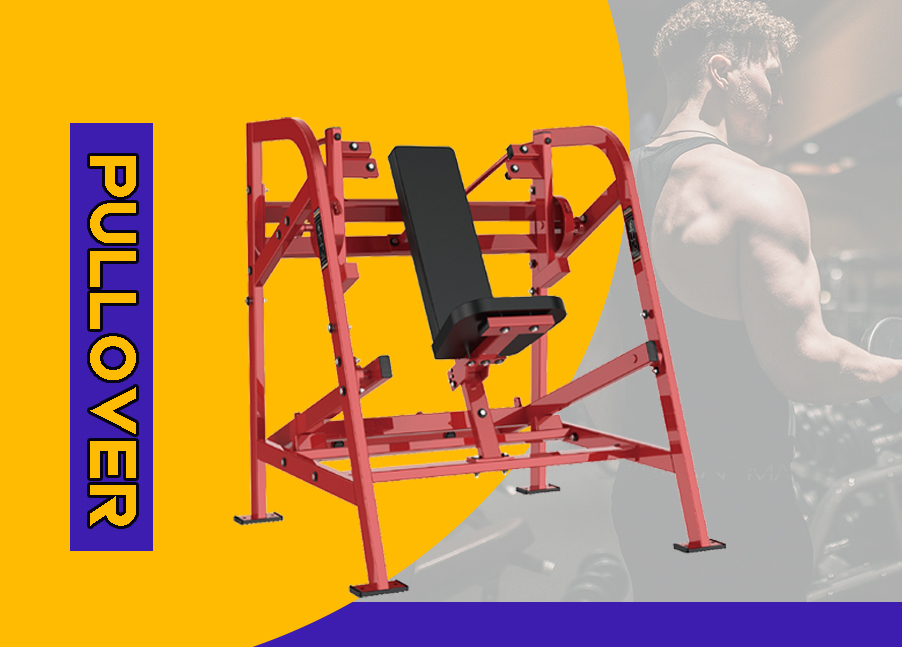
The latissimus dorsi and pectoralis major are the primary muscles targeted by the pullover machine, driving the entire movement. The machine’s overhead pulling motion perfectly matches the latissimus dorsi’s contraction trajectory. When pulling the handles from overhead to chest level, the lats undergo full stretching and powerful concentric contraction, activating all lat muscle fibers. This builds a wider back and creates a classic V-shaped torso.
Meanwhile, the upper fibers of the pectoralis major are fully engaged throughout the movement, coordinating with the lats to control motion speed and stability. Unlike bench presses that mainly thicken the chest, the pullover machine focuses on stretching and shaping chest muscles. It relieves tight chest muscles from prolonged sitting, enhances chest definition, and optimizes upper body proportions, offering unique value for torso shaping.
Secondary Activated Muscles: Triceps and Serratus Anterior
Triceps brachii and serratus anterior serve as key secondary muscles in pullover training, providing crucial auxiliary force. The triceps maintain continuous isometric contraction to stabilize the elbow joint and ensure steady force transmission. Though not the main driving muscle, they gain improved muscle tone and endurance from consistent training, refining upper arm lines.
The serratus anterior, often neglected in regular workouts, is fully activated during pullover movements. It controls scapular retraction and protraction with the machine’s motion, strengthening scapular stability. Well-developed serratus anterior muscles correct rounded shoulders and hunchback, boost shoulder girdle flexibility, and enhance overall upper body muscle coordination.
Stabilizing Muscles: Core and Shoulder Stabilizers
Core and shoulder muscles act as key stabilizers during pullover machine workouts. The entire core group, including abdominal and oblique muscles, stays tight to fix the torso, prevent waist shaking or overarching, and concentrate force on upper body muscles. This constant mild contraction effectively improves core stability and body control.
Anterior and medial delts, along with rotator cuff muscles, stabilize the shoulder joint throughout the movement. They control arm range of motion, avoid excessive joint rotation, and protect shoulder ligaments from injury. This exercise prioritizes shoulder muscle stability and endurance, helping balance shoulder muscle force and prevent chronic strain.
Conclusion
The pullover machine is a practical upper body training device that integrates muscle stretching, contraction and stabilization. It targets core lat and chest muscles for better torso proportions, activates auxiliary arm and scapular muscles, and strengthens core and shoulder stability. Suitable for both fitness beginners and seasoned enthusiasts, it enriches training diversity and breaks muscle growth plateaus. Standard movements and steady rhythms can maximize muscle activation for safe, efficient training results.


