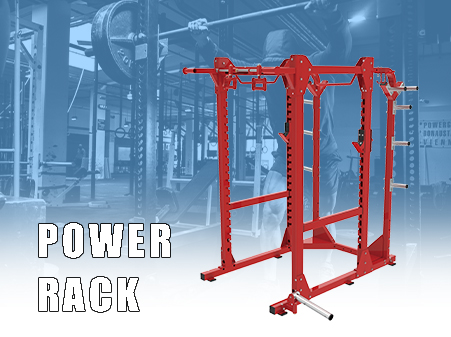
The power rack machine is a versatile strength training equipment.It allows users to perform squats, bench presses and pull-ups with reliable safety protection.
A power rack, also known as a squat rack, is one of the most versatile and essential pieces of equipment in commercial gyms and home gyms. Equipped with adjustable safety bars, J-hooks, and an integrated pull-up bar, it supports nearly all barbell compound lifts and customized strength movements. Unlike single-function gym machines that target isolated muscles, a power rack focuses on compound training, activating multiple muscle groups at once to build overall strength, muscle mass and body stability. Its targeted muscles can be divided into three major categories: upper body pushing and pulling muscles, lower body prime mover muscles, and deep stabilizer core muscles.
Upper Body Muscles for Pushing and Pulling Movements
Major Lower Body Muscles for Compound Lifts
Core Stabilizer Muscles for Whole-Body Balance
Conclusion
Upper Body Muscles for Pushing and Pulling Movements
The power rack fully covers upper-body push and pull workouts, covering chest, back, shoulder and arm muscles through different barbell and bodyweight exercises. For pushing movements, barbell bench press and overhead press are the most common rack-based workouts. Flat bench press mainly activates the pectoralis major, anterior deltoids and triceps brachii, while standing overhead press targets medial and posterior deltoids, upper trapezius and triceps to strengthen shoulder mobility. These pushing exercises build upper-body pressing power and improve upper limb muscle coordination.
For pulling movements, the built-in pull-up bar and rack pull function develop the entire posterior upper body. Wide-grip pull-ups focus on the latissimus dorsi, rhomboids and biceps, shaping a wider back and boosting arm pulling strength. Rack pulls, a modified deadlift fixed on rack safety pins, overload the middle trapezius, erector spinae and forearm flexors, greatly improving grip strength and back thickness. Even beginner-friendly bent-over barbell rows finished inside a power rack can stabilize the scapula and strengthen mid-back muscles effectively.
Major Lower Body Muscles for Compound Lifts
Lower-body training is the core function of a power rack, as it provides full safety protection for heavy-load leg workouts, which are impossible to complete safely without rack safety accessories. Barbell back squat, regarded as the king of lower-body exercises, is the most representative rack movement. It primarily engages the quadriceps femoris, gluteus maximus, hamstrings and hip adductors, meanwhile stimulating thigh deep muscles to enhance lower-body explosive force. Adjusting foot width can shift muscle focus: wide-stance squats emphasize glutes and inner thighs, while narrow-stance squats put more pressure on quads.
Besides squats, conventional deadlifts, barbell lunges and split squats done in a power rack further polish lower-body muscle groups. Full deadlifts activate posterior chain lower muscles including hamstrings, glutes and calf gastrocnemius. Barbell walking lunges fix stable bar height via J-hooks, targeting unilateral leg muscles and correcting leg muscle imbalance. Different from leg press machines that reduce joint pressure, power rack lower-body lifts require natural joint flexion and extension, which build functional leg muscle strength applicable to daily activities and sports performance.
Core Stabilizer Muscles for Whole-Body Balance
Most gym-goers ignore that nearly all heavy rack lifts rely on core muscles to maintain torso rigidity, making the power rack an excellent tool for functional core training instead of superficial abdominal exercises. During heavy squats, presses and deadlifts, the entire deep core system works continuously to prevent torso bending or collapsing. The transversus abdominis, internal and external obliques, and multifidus act as the main stabilizers to protect the lumbar spine and transfer muscle force between upper and lower body.
Additionally, users can finish dedicated core workouts on the rack pull-up bar. Hanging leg raises target lower abs and hip flexors, while hanging twists engage oblique muscles to shape waistline muscles. Unlike floor crunches that only train superficial rectus abdominis, rack-based core movements build anti-bending and anti-rotating core strength. This functional core fitness not only boosts lifting performance but also improves daily posture, reduces lumbar strain and avoids sports injuries during high-intensity training.
Conclusion
In short, a power rack works almost all skeletal muscles of the human body. It covers superficial shaping muscles of the upper body, load-bearing muscles of the lower body, and deep stabilizing core muscles. Its biggest advantage is adjustable training intensity: fitness beginners can practice standard movements with light weights, while advanced lifters can do heavy compound lifts with guaranteed safety. For anyone aiming to gain muscle, improve strength or keep functional fitness, a power rack is an all-in-one training device with comprehensive muscle-building effects.

